What Strengthens Hope?
Hope is more than a state of mind. Research is uncovering what helps us develop it, sustain it, and regain it when life changes.
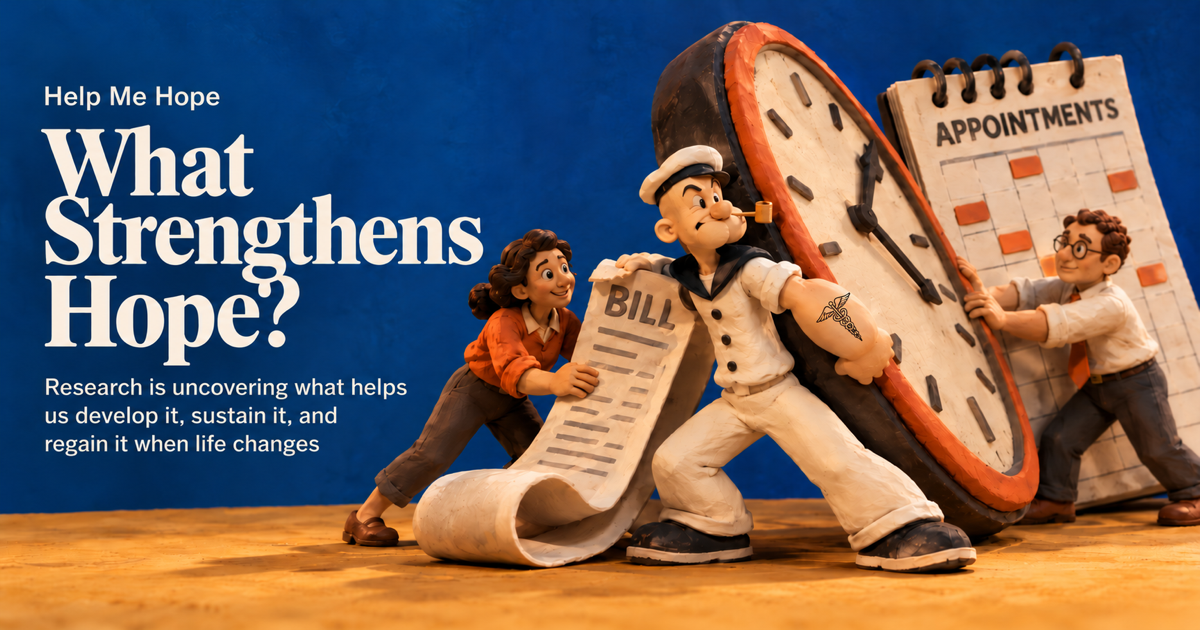
Managing a health condition can require reorganizing daily life. People need to obtain insulin and supplies. Appointments have to fit around work. Instructions have to be understood well enough to use when a question comes up at home. In interviews with 30 adults diagnosed with type 1 diabetes, researchers found that learning about the condition and learning to live with it were distinct, interrelated processes. Participants described feeling overwhelmed, managing fears at work and struggling with demands that continued long after the first teaching session. 7
The same gap appears elsewhere in care. In a study of women receiving cancer treatment who were experiencing financial distress, one participant described arranging appointments around payday to cover travel costs. In research on high blood pressure, patients and clinicians described difficulties obtaining suitable home monitors, sharing readings and arranging follow-up. Knowing what needs to happen does not settle how it will happen. 8, 9
A T1D Exchange resource available in 2025 cites approximately 64,000 new type 1 diabetes diagnoses annually in the United States, averaging about 175 a day. Each diagnosis introduces a new set of demands into someone’s life, with implications for families and the professionals helping them learn to manage it. 10
These experiences raise questions that education alone may not answer. Does the person feel able to begin and sustain what is being asked of them? Can they identify a workable way to do it? What happens when that route becomes unavailable? Hope research provides ways to study these questions and to test the support that might help.

What strengthening hope involves
Hope research examines how people pursue what they value, including under uncertainty or constraint. In one established account, agency is the perceived capacity to initiate and sustain movement toward a goal; pathways thinking is the perceived capacity to generate and use workable routes toward it. Other approaches examine additional emotional and relational dimensions of hope. The studies discussed here use different measures, so their results need to be interpreted in that context. 1, 4
An intervention designed around agency and pathways begins with what the person wants to accomplish or preserve. That may be continuing to work, caring for a family member or participating in decisions about treatment. The work then becomes specific: identifying a manageable action, considering obstacles, developing alternatives and arranging support. These are ways to translate the framework into a program that can be tested.
The person’s priorities need to be understood alongside the clinical plan. A recommendation may be medically appropriate but difficult to follow given someone’s work schedule, finances or responsibilities. Asking how it will fit creates an opportunity to identify a problem before the person has to manage it alone.
Access and agency require separate attention. Someone may feel ready to act but have no affordable way to obtain what they need. Someone else may have the necessary resources but feel unable to manage the demands ahead. Neither situation can be understood by assuming that a person needs more motivation. Strengthening hope has to be considered alongside the conditions that make action possible.
Support after the explanation ends
Programs that increase measured hope are not necessarily designed specifically to strengthen it. Education and collaborative care studies can nevertheless help identify forms of support worth testing. In a randomized trial of 75 people receiving dialysis, participants received routine care, five educational sessions, or the same sessions followed by telephone support. During calls three times a week for two months, participants could revisit the material and ask questions. 4
Both educational groups had higher hope scores at follow-up than the routine-care group, and the group receiving calls had higher hope scores than the group receiving education alone. The result suggests that continued support deserves investigation as part of efforts to strengthen hope. It does not establish that the program improved health or quality of life, and the small study could not determine which aspects of the additional contact accounted for the difference. 4
A second randomized trial involved 60 adults with multiple sclerosis and their caregivers. The collaborative care program included discussion of care problems, education and follow-up. At 12 weeks, both adults with multiple sclerosis and caregivers assigned to the program had higher average hope scores than their respective routine-care groups. The study cannot establish that the same approach would work across conditions. It also did not demonstrate improved daily functioning or changes in disease progression. 6
These studies examine specific forms of support: continued contact, opportunities to ask questions and participation in planning care. A program may need to help someone reconsider an approach after it proves unworkable. Research can then test whether that support changes hope, which parts contribute and whether the effects last.

What a measure of hope could tell us
Measuring hope allows researchers to examine experiences that a clinical result alone does not describe. The Adult Hope Scale assesses relatively enduring goal-directed thinking, while the State Hope Scale assesses current agency and pathways. Choosing an instrument requires attention to who will complete it and what the evaluation is intended to learn. 1, 2, 3
A study of 90 young people with type 1 diabetes illustrates why researchers are interested. Higher hope scores were associated with fewer depressive symptoms, more frequent mealtime insulin boluses and lower HbA1c, a measure of longer-term glucose levels. Because the study examined these relationships at one time, it could not establish that hope caused better diabetes management. The findings identify a relationship to investigate, rather than an effect that a hope intervention has already demonstrated. 5
One proposed application to evaluate is whether hope measures help care teams recognize difficulties with sustaining action or identifying workable options. Responses could inform conversations about what has become harder and what support is available. A score cannot explain someone’s circumstances or prescribe the response they need.
Measurement also creates responsibilities. If a team asks whether someone sees a way forward, it needs a way to respond when the answer reveals difficulty. That response might involve further education, a revised plan, practical assistance or referral to appropriate support. A questionnaire cannot replace that work.
From a higher score to a better experience of care
Whether measuring hope and responding to the results improves care remains a separate question. Researchers would need to compare this approach with an appropriate alternative, specify how teams use the information and follow outcomes over time.
Those outcomes should include what people are able to do in daily life. Can they attend appointments, manage responsibilities, participate in decisions or continue activities they value? Does distress decrease? Does quality of life improve? Clinical outcomes can be assessed alongside these experiences, with studies designed to determine whether changes in hope contribute to any benefit.
Evaluation must also examine whether support makes identified routes usable. Financial and practical barriers may require changes to services, not just changes to a person’s plan. Reduced hope under those conditions should never be treated as personal failure.
For Help Me Hope, these questions guide the development and evaluation of data-informed education and support, including programs, apps and tools. The aim is to understand what helps people identify options, feel able to act and sustain that capacity as circumstances change.
Hope research can help examine the gap between treatment recommendations and everyday life. Its clinical value will depend on whether that understanding leads to support people can use and improvements they experience.
Sources
- Snyder CR, Harris C, Anderson JR, et al. The will and the ways: Development and validation of an individual-differences measure of hope. Journal of Personality and Social Psychology. 1991;60(4):570–585.
- Snyder CR, Sympson SC, Ybasco FC, Borders TF, Babyak MA, Higgins RL. Development and validation of the State Hope Scale. Journal of Personality and Social Psychology. 1996;70(2):321–335.
- Snyder CR, Hoza B, Pelham WE, et al. The development and validation of the Children's Hope Scale. Journal of Pediatric Psychology. 1997;22(3):399–421.
- Poorgholami F, Mansoori P, Montaseri Z, Najafi K. Effect of Self Care Education with and without Telephone Follow-Up on the Level of Hope in Renal Dialysis Patients: A Single-Blind Randomized Controlled Clinical Trial. International Journal of Community Based Nursing and Midwifery. 2016;4(3):256–264.
- Calkins-Smith AK, Marker AM, Clements MA, Patton SR. Hope and mealtime insulin boluses are associated with depressive symptoms and glycemic control in youth with type 1 diabetes mellitus. Pediatric Diabetes. 2018;19(7):1309–1314.
- Rakhshan M, Ganjalivand S, Zarshenas L, Majdinasab N. The Effect of Collaborative Care Model-Based Intervention on Hope in Caregivers and Patients with Multiple Sclerosis: A Randomized Controlled Clinical Trial. International Journal of Community Based Nursing and Midwifery. 2018;6(3):218–226.
- Due-Christensen M, Willaing I, Ismail K, Forbes A. Learning about Type 1 diabetes and learning to live with it when diagnosed in adulthood: two distinct but inter-related psychological processes of adaptation. A qualitative longitudinal study. Diabetic Medicine. 2019;36(6):742–752.
- Liang MI, Simons JL, Herbey II, et al. Navigating job and cancer demands during treatment: A qualitative study of ovarian cancer patients. Gynecologic Oncology. 2022;166(3):481–486.
- Lauffenburger JC, Barlev RA, Khatib R, et al. Clinicians’ and Patients’ Perspectives on Hypertension Care in a Racially and Ethnically Diverse Population in Primary Care. JAMA Network Open. 2023;6(2):e230977.
- T1D Exchange. Pre-Symptomatic T1D Screening and Monitoring: A Quality Improvement Change Package. Funded by Breakthrough T1D; available in 2025. Annual estimate of 64,000 U.S. diagnoses; approximate daily average calculated as 64,000 ÷ 365.